
SEO in the Age of AI Search: How to Optimize for Google AI Overviews, ChatGPT, and Perplexity
Introduction
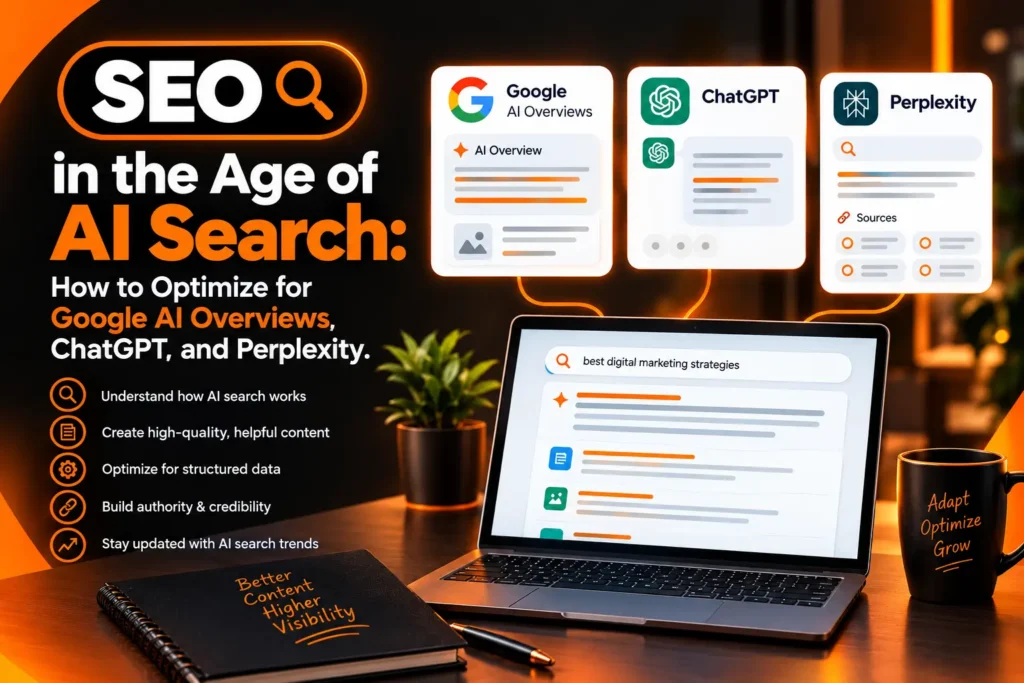
Search engine optimization is evolving rapidly, and Google AI Overviews Optimization is becoming an important part of modern SEO strategies. As users increasingly rely on AI-generated answers from Google, ChatGPT, and Perplexity, businesses need to adapt their content strategies to maintain online visibility and reach their target audiences.
Traditional SEO focuses on improving search engine rankings and attracting organic traffic. However, AI-powered search introduces new opportunities to make your content visible in generated answers, source citations, and conversational search results.
This is where Google AI Overviews Optimization, Answer Engine Optimization (AEO), and Generative Engine Optimization (GEO) become relevant. By creating helpful content, demonstrating expertise, and organizing information clearly, businesses can improve their chances of being discovered across traditional and AI-powered search experiences.
In this guide, you will learn how AI search is changing SEO, how Google AI Overviews work, and which optimization techniques can help improve your website’s visibility.
What's Actually Changed
Google AI Overviews Optimization
Google AI Overviews provide AI-generated summaries for selected search queries, often with links to relevant sources. These summaries can help users understand a topic without having to visit several websites.
Google AI Overviews Optimization involves creating accurate, useful, well-structured content that addresses search intent and can serve as a helpful source for AI-generated answers.
Ranking highly in traditional search results does not guarantee that your website will appear in an AI Overview. Therefore, businesses should focus on content quality, topical relevance, website accessibility, and clear explanations rather than relying only on keyword rankings.
ChatGPT and Perplexity Search Optimization
AI-powered platforms such as ChatGPT and Perplexity allow users to ask detailed questions and receive conversational answers. Depending on the platform and search features being used, these answers may include links and citations to online sources.
To improve visibility across these platforms, publish trustworthy information, answer specific questions, support claims with reliable sources, and build your website’s reputation within your industry.
The Impact of Zero-Click Searches
Zero-click searches occur when users find the information they need directly on a search results page without visiting another website. AI-generated summaries can contribute to this behavior.
Although this may reduce clicks for some queries, appearing as a cited source can still introduce your brand to potential customers. A balanced SEO strategy should focus on search visibility, relevant website traffic, brand recognition, and conversions.
SEO vs. AEO vs. GEO
Understanding the differences between SEO, AEO, and GEO helps businesses develop a more complete search optimization strategy.
Search Engine Optimization (SEO): Focuses on improving organic search visibility, rankings, and relevant website traffic.
Answer Engine Optimization (AEO): Focuses on presenting clear, direct answers that may be useful for featured snippets, voice search, and AI-powered answers.
Generative Engine Optimization (GEO): Focuses on improving the likelihood that content and brand information will be discovered, referenced, or cited by generative AI systems.
These approaches share many fundamentals, including helpful content, technical accessibility, topical expertise, and a positive user experience.
How AI Search Engines Choose Sources
1. Create Clear and Well-Structured Content
Content structure plays an important role in helping readers and search systems understand information. Use descriptive headings, short paragraphs, bullet points, numbered steps, and comparison tables where appropriate.
For effective Google AI Overviews Optimization, answer the main question directly near the beginning of the relevant section. Follow that answer with supporting details, examples, and reliable evidence.
2. Demonstrate Experience and Expertise
Useful content should demonstrate first-hand experience where relevant, accurate information, and knowledge of the subject. Include author information, original examples, credible references, and transparent explanations of how information was gathered.
Google’s E-E-A-T framework refers to Experience, Expertise, Authoritativeness, and Trustworthiness. These concepts help explain important qualities of reliable content, although E-E-A-T is not a single direct ranking factor.
3. Publish Original and Helpful Information
Original research, customer insights, case studies, expert commentary, and practical examples can make your content more valuable than generic articles.
Rather than repeating information already available online, explain what you have learned, provide supporting evidence, and offer actionable recommendations. This can strengthen your website’s credibility and make your content more useful to readers and potential AI citations.
4. Use Structured Data Correctly
Structured data helps search engines interpret specific information about a webpage. Depending on the content, relevant types may include Article, BreadcrumbList, Organization, and LocalBusiness.
Implement valid schema markup that accurately reflects the visible content on your page. Structured data does not guarantee inclusion in Google AI Overviews or citations in AI-generated answers.
Practical Google AI Overviews Optimization Strategies
Here are practical steps to improve your website content for modern search experiences.
Answer questions directly: Provide a concise, accurate answer near the beginning of each relevant section.
Use descriptive headings: Organize your content around the questions and topics your audience searches for.
Include relevant keywords naturally: Use Google AI Overviews Optimization and related terms where they fit the context.
Publish original insights: Add real examples, research, data, and professional experience.
Build topical authority: Create related articles that cover your main subject in sufficient depth and connect them through relevant internal links.
Strengthen your online presence: Maintain consistent business information, author details, and relevant professional profiles.
Earn trustworthy backlinks: Develop genuinely useful resources that other relevant websites may want to reference.
Improve technical SEO: Ensure search engines can crawl your important pages and that your website offers a good mobile experience.
Refresh outdated information: Review older articles and update statistics, examples, references, and recommendations when necessary.
Optimize for user intent: Address the real problem behind a search query instead of focusing exclusively on exact-match keywords.
These practices support traditional SEO while helping your content remain useful in AI-driven search environments.
Measuring Success in an AI-Search World
Website traffic remains an important performance indicator, but it should not be the only measure of SEO success.
To evaluate your Google AI Overviews Optimization efforts, monitor relevant metrics such as:
Organic impressions and clicks in Google Search Console.
Search rankings for important keywords.
Organic traffic and conversions from search.
Referral traffic from AI-powered platforms where available.
Brand mentions and citations in AI-generated answers.
Engagement, qualified leads, and enquiries.
Changes in visibility for important informational and commercial queries.
Google Search Console does not provide a universal, dedicated report covering every AI Overview appearance. AI visibility tracking may therefore require additional tools and careful manual checks.
When testing ChatGPT, Perplexity, or other AI platforms, use consistent questions and record the sources they cite. Treat individual results as observations rather than proof of a guaranteed ranking position.
Common Mistakes to Avoid
Avoid these common mistakes when adapting your SEO strategy for AI-powered search:
Repeating keywords unnaturally throughout an article.
Publishing generic content without original insights or useful evidence.
Hiding the main answer beneath unnecessary introductory text.
Assuming that a number-one organic ranking guarantees an AI Overview citation.
Adding structured data that does not match the visible page content.
Ignoring technical SEO, mobile usability, and internal linking.
Treating AEO and GEO as completely separate from traditional SEO.
Measuring success only through website visits while ignoring brand visibility and conversions.
The goal is to create content that genuinely helps people while making your expertise and information easy to understand.
Conclusion
AI-powered search is changing how people discover information, compare solutions, and evaluate businesses. Google AI Overviews Optimization can be a valuable part of a broader SEO strategy that also considers ChatGPT, Perplexity, and traditional search engines.
Focus on creating helpful content, answering questions clearly, demonstrating expertise, maintaining strong technical SEO, and building a trustworthy online presence. While no technique guarantees an AI Overview placement or citation, these fundamentals can improve the overall quality and discoverability of your website.
By combining traditional SEO with relevant AEO and GEO practices, businesses can prepare for changing search experiences and build a sustainable online presence in the age of AI search.